
You may be wondering how I chose the name for this website. I imagine the play on words with my name feels obvious, but there are many layers here.
I preached a sermon on Exodus 17 in November of 2022. I had just returned from a trip to Jordan, Israel, and Palestine and I found myself mulling over the concept of wilderness. At one point we were driving through a remote part of Jordan from Mount Nebo to the Dead Sea. I looked out the car window into the rocky beige which never seemed to end, and had a new insight into the Exodus story: I could understand how the Israelites were furious with Moses–there was no water, shade, or wildlife in sight. I know that the Exodus story likely occurred in the Sinai peninsula (not where we were in Jordan) and that climate change and humans have impacted the terrain over thousands of years. And yet, I was stuck by a new understanding of the hopelessness and desperation of sustaining life in the desert wilderness. I also realized that my mental abstraction for wilderness was the mountains of Western North Carolina (A special place to me and my family, and maybe to some of you). The “wilderness” of Western North Carolina is actually quite peaceful. Right as you think you’re lost you might stumble upon a fresh mountain stream or a baby deer or a cute chickadee–how lovely! I laughed at myself that day in the car because I realized that my image of wilderness was likely the exact opposite of what the writer of Exodus hoped to convey.
I began to wonder about wilderness both literally and metaphorically. Wilderness is a popular theme in our Church consciousness: I’ve heard the pandemic years described as an unending wilderness experience and I’ve heard Christians describe difficult seasons of life as “wilderness.” We relate to the wandering Israelites following Moses through uncertainty. We know that the ancient Israelites weren’t just hopelessly lost for 40 years, but that they were being transformed in the wilderness: They were growing from a people enslaved and in exile to a people moving into to a promised land of freedom. Transformation had to take place within each of them and as a collective as they journeyed and grew. It’s this element of a wilderness of the soul that has inspired writers, artists, and theologians for centuries.
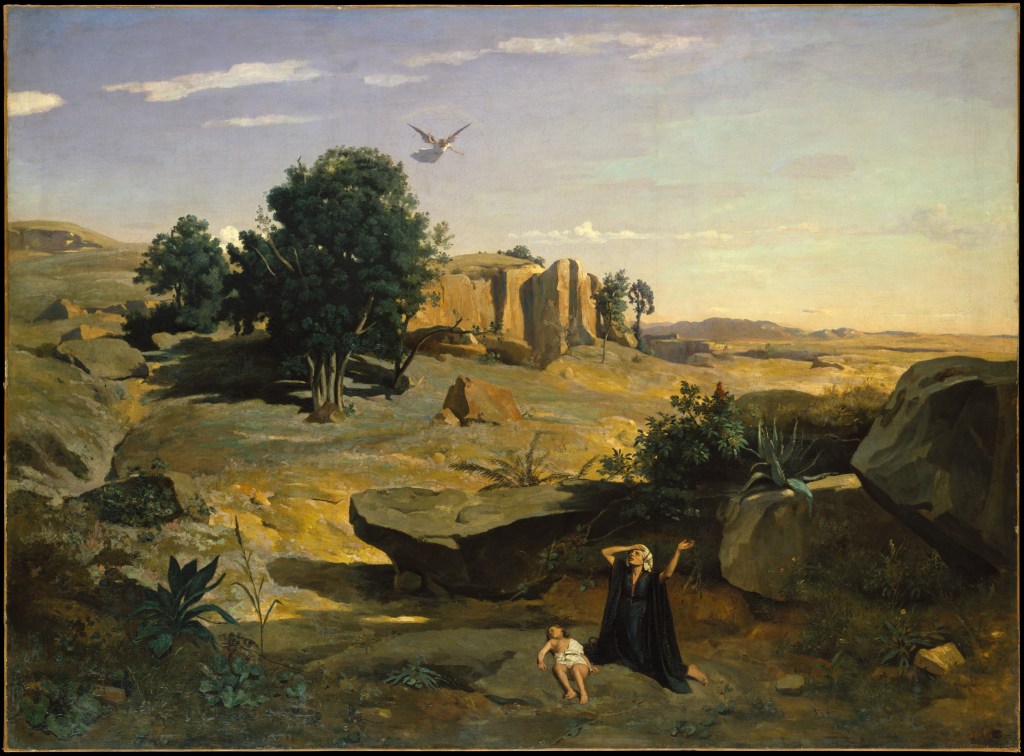
The most profound theological takeaway from Exodus, in my opinion, is that God appears in the wilderness. This is not a new insight–liberation theology has discussed this in depth, which I imagine I will write about at another time. Every wilderness story in the Bible is coupled with God’s grace: Hagar sees God’s face; Manna rains from heaven; Moses’s staff brings forth water (I could go on!).
The nature of God is to make a way out of no way. God obviously wants us to know this because we see God’s transforming work through hopelessness and wilderness over and over and over again in scripture. I’m not saying that we need to be in a hopeless, wilderness place to experience God’s in-breaking into our lives, but that the Good News is that God is always making a way out of no way.
I hoped that this thinking and story of Grace in the Wilderness would inform my writing and reflections: that God is at work in the world if only we are willing to notice God. I also thought it was tongue-in-cheek to suggest that a young, female, Presbyterian pastor was in a spiritual wilderness among Jesuits and college students. So far, I have felt at home in my new home at Georgetown!
Thanks for joining me on this journey! I hope you can pay attention to God at work in your life, and the lives of those around you.
Text copyright © 2023 Grace Woodward. All rights reserved.
 Grace in the Wilderness
Leave a comment